
|
|
Hello, and welcome the the Presidential Archives Project. The mission of this program is to catalog and share some of the most important presidential speeches from American history. Each page includes a transcription of the speech, a brief overview of its background and, when possible, an audio recording of the speaker. Thank you for you interest in keeping this important national history alive! -P.A.P. Staff |
|
|
|
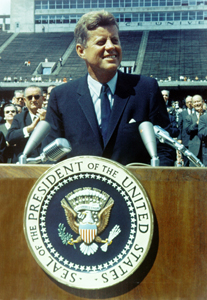
After defeating Republican candidate Richard Nixon in late November 1960, John F. Kennedy began collecting thoughts and ideas for his inauguration speech. He sought suggestions from various friends, aides, counselors, and clergymen. Kennedy then made several drafts, combining those ideas with his personal reflections. Heavy snow fell the night before John F. Kennedy's inauguration, but thoughts about cancelling the plans were overruled. Kennedy attended Holy Trinity Catholic Church in Georgetown that morning before joining President Eisenhower to travel to the Capitol. The Congress had extended the East Front, and the inaugural platform spanned the new addition. The oath of office was administered by Chief Justice Earl Warren. Robert Frost wrote a poem in the president's honor, entitled "Dedication", which he read from a hand-written draft. John F. Kennedy's inaugural address, better known as "Ask Not" was delivered on Friday, January 20, 1961. This speech include's the famous quote, "Ask not what your country can do for you," by which Kennedy challenges the American public to contribute more to the betterment of their country. He follows this statement with a series of questions which address a wide variety of topics from the future of economic growth, to the state of education, to the importance of the space program and the military, to the subject of race relations. |
 |
|
 |
|||
John F. Kennedy My fellow Americans, ask not what your country can do for you, ask, “Can a nation organized and governed such as ours endure?” Are we doing enough today? Is our strength and prestige rising? Do people want to be identified with us? Do they want to follow the United States leadership? Is our relative strength growing? Can we carry through in an age where we will witness not only new breakthroughs in weapons of destruction, but also a race for mastery of the sky and the rain, the ocean and the tides, the far side of space and the inside of men’s minds? But does it follow from this that big government is growing relatively bigger? At what point, for example, does military aid become burdensome to a country and make its freedom endangered rather than helping to secure it? Or at what stage can a new weapons system be considered sufficiently advanced to justify large dollar appropriations? Many years ago, Woodrow Wilson said, what good is a political party unless it is serving a great national purpose? And what good is a private college or university unless it is serving a great national purpose? What will be done to provide equality of education in all sections of the United States? How do we eradicate the barriers which separate substantial minorities of our citizens from access to education and employment on equal terms with the rest? Finally, what can we do to move from the present pause toward enduring peace? What kind of peace do I mean, and what kind of peace do we seek? How can we develop and sustain strong and stable world markets for basic commodities without unfairness to the consumer and without undue stimulus to the producer? How can we take advantage of the miracles of automation with the great demand that it will put upon highly skilled labor and yet offer employment to the half million of unskilled school dropouts each year? How, in sum, can we make our free economy work at full capacity? Will we in this country adapt our thinking to these new prospects and patterns--or will we wait until events have passed us by? My fellow citizens of the world, ask not what America will do for you, but what together we can do for the freedom of man. (Applause) |
||||
You may listen to the original audio recording of the speech here:
|
||||
